Restoring a CNC spot welding machine through bespoke electronics design
The challenge
When a manufacturer of sensors for the medical industry needed to double its production capacity during the COVID-19 pandemic, bringing an out-of-service machine back into operation became a priority.
The company already had a precision CNC spot welding machine in production, alongside a second machine that had been sitting unused in storage after its original CNC control system failed.
Rather than investing in an entirely new machine, the manufacturer approached S&T Controls to develop a bespoke control solution that would restore the existing equipment to working order.
The project also took place in the midst of the global semiconductor shortage, when electronic component availability was severely restricted and supply chains were under significant pressure.
With demand increasing rapidly, the project needed to be completed within a matter of weeks, despite these challenging market conditions. There was also one important requirement: the new system had to operate without a PC.
The solution
S&T Controls designed and developed a bespoke electronic control system to replace the obsolete CNC equipment, combining custom PCB design, microcontroller programming and modifications to the machine's existing electrical controls.
The spot welding machine used a rotary table with two fixtures, allowing an operator to load components on one side while the machine welded components on the other. An X-Y positioning table, driven by stepper motors, was responsible for accurately positioning six spot welds with varying profiles.
To restore this functionality, S&T Controls developed a system using two microcontrollers. One managed the rotary table, while the other controlled the welding sequence, positioning and operator interface.
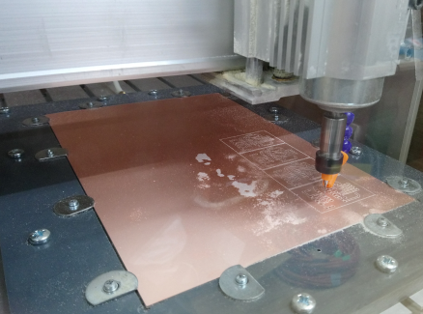
A bespoke PCB was designed and manufactured, incorporating optical isolation, relays and electrical noise suppression measures to ensure reliable operation in an electrically demanding industrial environment.
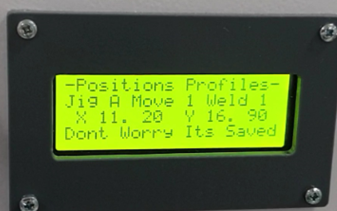
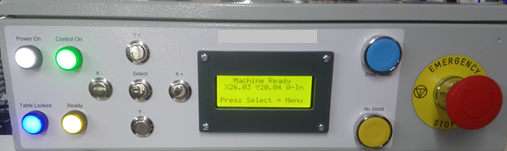
The system also incorporated an LCD display and operator controls, with the machine's existing control panel modified to accommodate the required power supplies, contactors and stepper motor drives.
Overcoming the technical challenges
One of the key challenges was ensuring the machine could accurately position multiple welds across different products and fixtures without relying on a computer.
The global semiconductor shortage added another layer of complexity to the project, with electronic component availability presenting an additional consideration throughout the design and development process. This was particularly challenging given the urgency of the manufacturer's production requirements.
S&T Controls developed embedded control software capable of storing and recalling individual welding coordinates and profiles. The system calculated the required stepper motor movements between positions, allowing the machine to move accurately and consistently through each welding sequence.
The control system was initially configured to accommodate two different products, each with multiple fixtures and weld positions.
Safety was another important consideration. During development, an additional circuit was incorporated into the emergency machine-off system, ensuring the machine would shut down safely if the relevant control connection was disconnected.
Extensive testing and refinement followed, including checking the positioning accuracy, welding sequences, operator controls and safety functions.
The results
The completed machine achieved a verified positioning repeatability of 10 micrometres (0.01 mm), demonstrating that the bespoke replacement control system could deliver the precision required for the manufacturer's production processes.
Following successful testing, electromagnetic compatibility (EMC) checks and conformity documentation, the refurbished CNC spot welding machine was returned to the customer and immediately put back into production.
Despite the challenges presented by both the COVID-19 pandemic and the global semiconductor shortage, the project enabled the manufacturer to increase its production capacity at a critical time, making use of existing machinery rather than purchasing an entirely new system.
S&T Controls subsequently developed a software update to accommodate a third product, extending the machine's capabilities further.
Giving existing machinery a new lease of life
Obsolete electronics, failed control systems and difficulties sourcing replacement components don't always mean that valuable industrial machinery needs to be replaced.
Through bespoke electronics design, reverse engineering, custom PCB development and embedded control system design, S&T Controls helps businesses restore, upgrade and extend the working life of existing equipment.
By developing bespoke solutions tailored to the requirements of individual machines, businesses can reduce their reliance on obsolete components, avoid unnecessary equipment replacement and maintain essential production capabilities.
If your business has machinery affected by obsolete electronics, failed control systems or unavailable replacement parts, get in touch with S&T Controls to discuss how a bespoke electronics solution could help.